
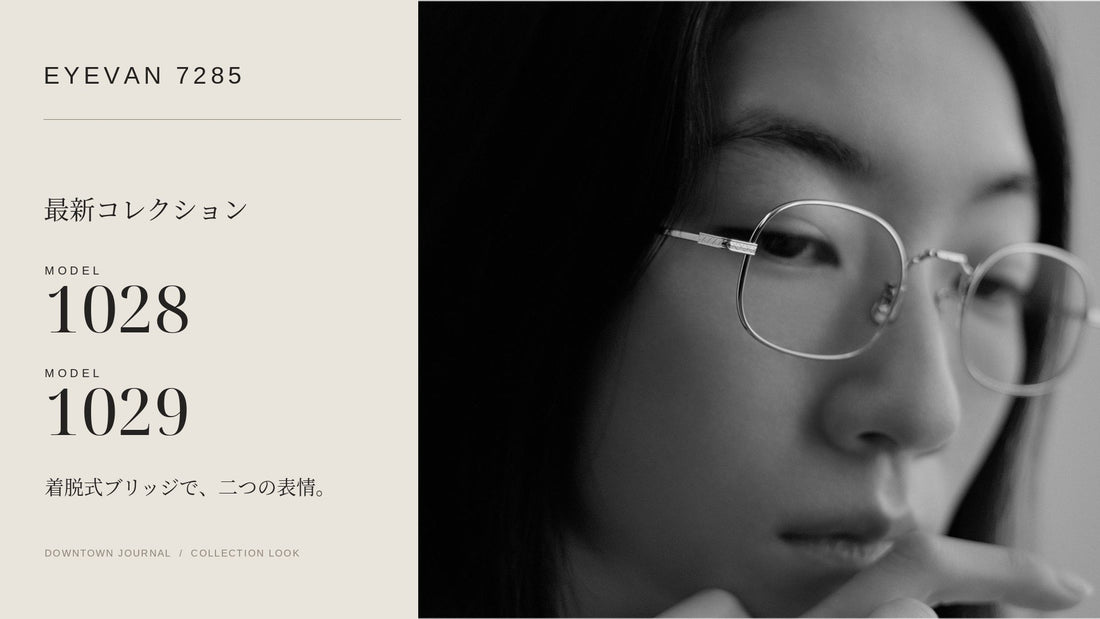
EYEVAN 7285: The 1028 and 1029
DOWNTOWN JOURNAL / NEW COLLECTION
Add one line to a fine metal frame and the whole expression changes. On EYEVAN 7285’s new 1028 and 1029, the upper bridge is removable, so each can be worn as a single- or double-bridge frame. The mechanism is shared, but the lens shapes are quite different. Here’s a closer look at both.
01 / THE BRAND
The story behind EYEVAN 7285
EYEVAN began in 1972 with the idea of eyewear as something to dress in. It made its international debut in 1985, and a new design team launched EYEVAN 7285 in 2013. The numbers in the name recall those first two dates.
The team looks beyond vintage eyewear for inspiration. Telescopes, hand mirrors, architecture and temple ornament all offer details that may reappear in the profile of a temple arm or the pattern on a piece of metal. The fine engraving and small fittings, crafted in Sabae, reward a closer look.
The designer: Hirotaka Nakagawa

Hirotaka Nakagawa worked in the machine-tool industry before spending about a decade in optical retail. He taught himself eyewear design and launched his own label before joining EYEVAN, where he continued working with customers in Osaka while also developing and designing collections. His work spans EYEVAN 7285, 10 eyevan and E5 eyevan.
A slight change in proportion, or the way a finish looks against the skin, can alter the feel of an otherwise familiar shape. Nakagawa credits his years on the shop floor with teaching him to notice those differences. Both models make that point in a small but visible way.
02 / THE MECHANISM
How the removable bridge works
The idea started with the rimless 1296. The 1028 and 1029 adapt its removable bridge to full-rim metal frames. The two ends of the upper bridge slot into fittings on the back of the rims. You can remove or attach it yourself, and the fixed lower bridge allows the frame to be worn either way.
Take the upper bridge off and the lens outline comes forward. Put it back and the extra line gives the frame a more defined expression. Look from the back as well as the front to see just how small the fittings are.


03 / MODEL 1028
1028: A softly angular silhouette
The 1028 resizes the lens shape of the 1016, itself inspired by a 1930s American eyewear catalogue. It has distinct angles, but the transitions are soft, giving it more definition than a round frame without the severity of a sharply geometric one.
Our col. 819 has a soft gold-toned finish. From the front, the metal outline is fine and unobtrusive; from an angle, it catches the light. Wear it without the upper bridge to let the softer shape stand on its own, or add it for a more defined look.


04 / MODEL 1029
1029: A cleaner horizontal line
The 1029 balances rounded corners with a clean horizontal line. It draws on late-1990s German and French designs and vintage American eyewear from the 1960s. Its wider silhouette looks sharper than the 1028, even with the same bridge configuration.
Our col. 820 comes in a subdued gunmetal tone. Removing the upper bridge leaves a particularly spare outline; adding it draws another line across the already horizontal front. This is the one we’d start with if you want the frame to bring definition to a simple outfit.


05 / SIDE BY SIDE
The two frames, side by side
Choose the 1028 for a softer outline, or the 1029 for a stronger horizontal line. Compare the two from the front with the upper bridges removed: the difference in lens shape is easier to see.
Both have fronts made from titanium and beta titanium, and beta-titanium temples. The sunglasses shown here use the brand’s own curved glass lenses made in Japan. Optical editions are also made; the lens description here applies only to the sunglasses featured in this article.
For availability and purchase enquiries, please see the individual product pages.
References: EYEVAN 7285 brand profile / 1028 / 1029 / EYEVAN designer interview (Japanese)